
A printer's guide to wedding stationery on Anglesey
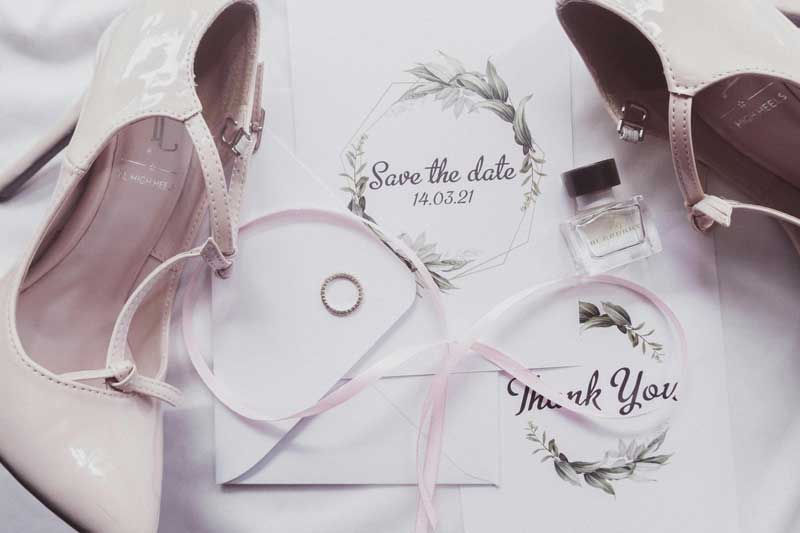
Most couples ordering wedding stationery from us are doing it for the first time. The pieces have different jobs, the timeline is unforgiving, and a fair bit of the language sounds like it was invented to confuse people. So this is the plain-English guide we'd offer anyone walking through our doors with a wedding to plan.
We've printed wedding stationery for couples on Anglesey and across North Wales for as long as anyone here can remember. Same family names some years, same nervousness about getting the invitation date right every single time. Some things never change.
What you'll actually need
A full wedding stationery suite isn't a fixed list. What you end up with depends on the size of your wedding, where it's held, and how much paper you want to put in front of your guests. But here's what couples typically order from us, in roughly the order it gets used:
- Save-the-dates. Optional, but useful if you're getting married in summer (when everyone has weddings on) or if a lot of guests need to travel. A small card sent six to twelve months ahead.
- Invitations. The headline piece. Typically sent six to eight weeks before the wedding, with the date, venue, time and details.
- RSVP cards. Often included with invitations. Some couples include a pre-paid envelope; others ask for emails or a wedding-website reply.
- Information or logistics cards. Where to stay, parking, dress code, transport. Useful if your venue is a long drive from anywhere.
- Order of service. For the ceremony itself: readings, hymns, the order of the day. Usually a small booklet, printed close to the wedding date.
- Table plan. A larger printed piece for the reception, telling guests where to sit.
- Place cards and menus. Smaller items for each guest at the reception table.
- Thank-you cards. Sent after the wedding, often the same style as the invitations and ordered alongside them.
You don't need all of these. A small wedding might be just invitations and an order of service. A bigger one will use the full set.
Working backwards from the wedding date
The timeline matters because some pieces need to go out months ahead, and others can wait until close to the day. A rough guide:
- Twelve to six months out: save-the-dates, if you're using them.
- Six to four months out: invitations, RSVPs, information cards. Sending these about six months ahead is normal for a UK wedding; eight months for a destination one.
- Six weeks out: orders of service, table plans, place cards, menus. By this point you know who's coming and you've finalised the ceremony.
- After the wedding: thank-you cards, sent within two months or so.
The single thing couples leave too late, in our experience, is the invitation. By the time you've chosen a design, worked the wording out, proofed it and we've printed it, six weeks have gone. If you want invitations in guests' hands six months before the wedding, we need to start the conversation about seven months out.
Paper, weight and finish
Most of what makes a piece of wedding stationery look and feel right is in the paper. Three things to think about:
Weight. Stationery weight is measured in grams per square metre (gsm). For wedding invitations, the sweet spot is 300 to 350gsm. Anything lighter feels like a flyer; anything heavier starts to feel like a coaster. For RSVP cards, 300gsm is fine. For order of service booklets, the inner pages can be 100 to 130gsm and the cover heavier.
Coated or uncoated. Coated stocks have a smooth, slightly shiny surface and reproduce colour photographs richly. Uncoated stocks have a more textured, natural feel that takes pen ink well (useful if you want to handwrite each guest's name). Most wedding stationery uses uncoated stocks because they feel more personal. Cotton-feel uncoated stocks are particularly popular and have a soft, slightly fibrous touch.
Finishes. Things like lamination (silk, matt or soft-touch) can lift the feel of a card considerably for relatively little extra cost on a wedding-sized run. Die cutting can give your invitation a non-rectangular shape or a decorative edge. These work well at wedding scale. Some other finishes (foil blocking, embossing, spot UV) are gorgeous but more economical at higher quantities; for typical wedding runs of 100 to 200, the per-card cost on those finishes can be steeper than couples expect. We'll be honest about what's worth it.
The bilingual question
On Anglesey and across North Wales, couples increasingly want their wedding stationery in Welsh, in English, or both. We've been printing bilingual stationery for as long as we've been printing stationery. A few things to know:
Fully bilingual stationery (Welsh and English on the same card) works beautifully but takes more space than a single-language layout. We'll usually design these with the two languages in parallel columns, or with one language as the primary and the other beneath, depending on the audience.
Some couples send English versions to English-speaking guests and Welsh versions to Welsh-speaking ones. That's two short print runs rather than one bilingual one, and the per-card price works out similarly.
If you'd like the whole suite in Welsh, we can do that. We've done it for couples across Anglesey, in Beaumaris, Llangefni, Aberffraw and dozens of villages in between. We know the conventions.
How we work with couples
There's no single way couples come to us. Some arrive with a clear vision and a designer's PDF; others have only a colour scheme and a wedding date. Both are fine.
If you have artwork ready, send it through and we'll proof it and quote. If you want us to design from scratch, our in-house design team can take a brief, mood-board it, and come back with a few options before any printing starts. Most couples land somewhere in between: they've sketched what they want, but need our help refining it.
Whatever the route, we'll proof everything before printing. That's a soft-copy PDF first, then a printed proof on the actual stock for the larger items. Wedding stationery is not where you save money on proofs.
A few honest things about wedding stationery
Three observations from couples we've worked with that might save you some grief:
Check the date and venue twice. Then check them again. We've never sent an invitation with the wrong date, but it's not because we're clever; it's because our team reads every proof multiple times. Be similarly paranoid with your own copy.
Watch the RSVP date. Make it earlier than feels comfortable. Suppliers (caterers, venues) need your numbers two to three weeks before the wedding, so the RSVP date needs to be at least four weeks out.
Order a few extra. Of everything. People lose invitations. You'll want a clean copy for the memory box. Photographers love to photograph the stationery. Ordering ten per cent extra costs very little; reprinting later is expensive.
Questions we get asked
How far in advance should we order wedding stationery?
Save-the-dates around twelve months out if you're using them. Invitations about six to eight months before the wedding, which means starting the conversation with your printer seven to nine months ahead. Orders of service, table plans, menus and place cards can wait until about six weeks before the day. Thank-you cards we would suggest ordering at the same time as the invitations, even if you send them after.
Can you print wedding stationery in Welsh, or bilingual Welsh and English?
Yes, both. We have been printing bilingual wedding stationery for couples across Anglesey and North Wales for years, and full-Welsh suites are an option too. If there is a particular Welsh-language convention you want followed (formality, place-name spellings, mutations), it is worth flagging at the brief stage so we can hold to it through proofing.
What is the typical minimum order for wedding invitations?
There isn't really a minimum on a digital print run, which is what most wedding stationery is. We have printed orders as small as 20 invitations and as large as 300. The per-card cost drops as the quantity goes up, so most couples order a few extras for keepsakes and last-minute additions to the guest list. Ordering 110 when you need 100 costs very little more than ordering 100.
Do all the pieces need to use the same design?
No, but most couples like them to feel related. A common pattern is a single visual element (a colour, a flower, a typeface, a motif) that appears across the suite, with the rest of each piece designed to suit its purpose. Invitations are formal, table plans are practical, thank-you cards are warm. Tying them with one consistent element keeps the suite recognisable without forcing every piece into the same layout.
What paper do you usually recommend for wedding invitations?
For most couples, a 300 to 350gsm uncoated stock with a slight cotton texture is hard to beat. It feels expensive in the hand, takes ink beautifully, and works for both modern and traditional designs. If you want something more contemporary, a smooth coated stock at the same weight prints colour photography crisply. We always quote the paper before printing, and we can send samples if you would like to feel a few options before deciding.
Thinking about your wedding stationery?
If you've got a wedding coming up, whether it's an intimate one at home, a full traditional one at a venue like Plas Rhianfa, or a destination wedding away from Wales with stationery posted out to guests, we'd be glad to help. We can do as much or as little as you'd like, from printing your own artwork to designing the whole suite alongside you. No matter how large or small, no upsell, no agenda.
Get in touch and we'll arrange a chat, or have a look at our wedding stationery page if you'd like to see what we mean. There's more on our history too if you'd like a look at how we got here.